
HPS GmbH
Booth number: 1F-08a
www.hps-gmbh.com
About us
HPS GmbH was founded in 2000 and, with HPS Romania and HPtex, has since grown into an independent group of three sites with more than 80 employees. HPS Group develops high-end space technology and delivers flight hardware for commercial and institutional space missions – on equipment up to subsystem level. HPS's business areas are:
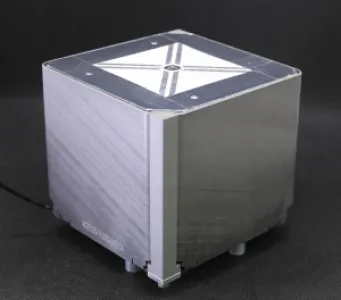
- Solid Reflector & CubeSat Antennas
- Large Deployable Reflector Subsystems & Booms
- Small Deployable Antennas
- Metal Mesh for Deployable Reflectors
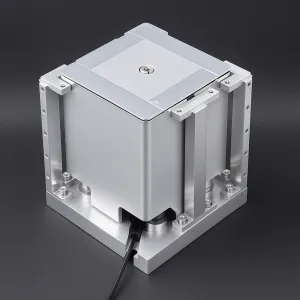
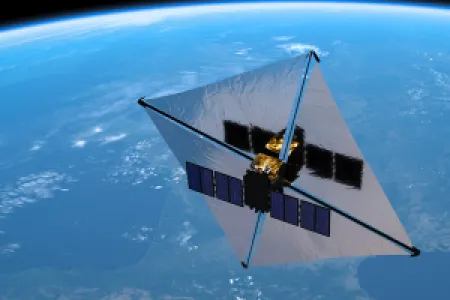
- Deorbit Dragsail Modules (ADEO)
- Thermal Hardware (MLI, Radiators, Straps)
- Secondary Structures
- MGSE and Purge Equipment.
HPS flies onboard of more than 30 space-missions.

-SWISSto12-thumb.webp)
Address
Hofmannstr. 25–27
81379 Munich
Germany
E-mail: dever@hps-gmbh.com
Phone: +49 89 45205760
Internet: www.hps-gmbh.com
Sos. Pantelimon, No. 10-12
Sector 2
021631 Bucharest
Romania
E-mail: office@hps-srl.ro
Phone: +40 31 102 9397
Internet: www.hps-srl.ro
Kirchenlamitzer Str. 115
95213 Muenchberg
Germany
E-mail: contact@hptex.de
Phone: +49 89 452057680
Internet: www.hptex.de
Contact person:
Dr.-Ing. Ernst K. Pfeiffer
CEO
E-mail: pfeiffer@hps-gmbh.com
Phone: +40 89 45205760
Dorottya Milankovich
Business Development Manager
E-mail: milankovich@hps-gmbh.com
Phone: +49 89 452057625
Horatiu Gheorghe
E-mail: gheorghe@hps-srl.ro
Phone: +40 31 10 29 397
Products & Services
HPS Group’s major product lines and services are:
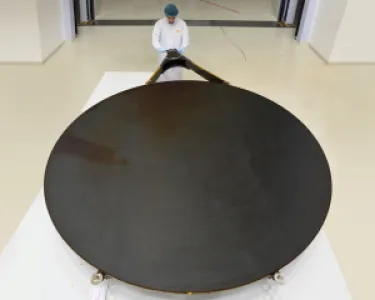
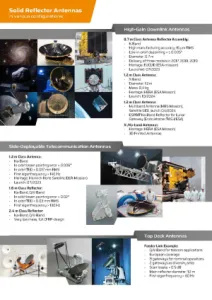
Solid Reflector Antennas:
- from 0,3 m up to 2,4 m
- X-band up to Ka-band and Q/V-band
- CFRP based or metal (for smaller ones)
- Flight projects: EUCLID, HERA, HEINRICH HERTZ, ESPRIT, VIGIL, RAMSES.
Large Deployable Reflector Subsystems:
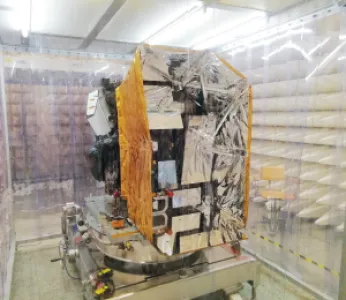
- Our LEA-LDRS-subsystems comprise mesh-reflector, arm, HDRM, thermal hardware, harness and deployment electronics
- up to 12 m reflector diameter
- up to 12 m deployable arm length
- Flight projects: CIMR (Copernicus, launch 2029), NeaStar-1 (launch 2029)
- We deliver also metal mesh alone, via our joint venture HPtex GmbH, Germany.
Small Deployable Antennas:
- for CubeSats and SmallSats
- from UHF up to Ka-band
- different deployment architectures.
Deorbit Dragsail Modules (ADEO):
- for Cubesats up to spacecraft of 1.500 kg
- for Orbits up to 900 km (optimal 500-700 km)
- 6 different versions available: ADEO-P, -C, -Nx, -N, -M, -L
- TRL 9 with flight heritage, such as: Electron (2018), ION (2021), ION (2023), EU IOV (2026)
- Order your ADEO now on IAC, HPS booth, German Pavillion or here: ADEO Configurator.
Thermal Hardware:
- MLI (Multi layer insulation)
- Sunshields
- Radiators (OSR based or painted)
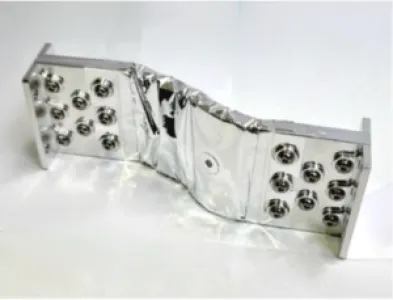
- Thermal Straps
- Thermal Washers.
Secondary Structures:
- Lightweight architecture
- Metal or Composite
- Subassemblies up to subsystems
- Flight projects: EnMap Baffle, Gateway/iHAB internal secondary structures.
Mechanical Ground Support Equipment (MGSE):
- Integration Stands
- Turntables
- Hoisting Devices
- Transport containers
- Test adapters.
Large Deployable Reflector Subsystems
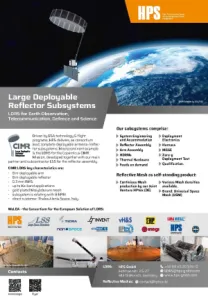
Driven by ESA technology & flight programs, HPS delivers, as consortium lead, complete deployable antenna-/reflector-subsystems. Most prominent example is the LDRS for the Copernicus CIMR Mission, developed together with our main partner and subcontractor LSS for the reflector assembly. CIMR LDRS key characteristics are:
- 8 m deployable arm
- 8 m deployable reflector
- 0.3 mm RMS
- up to Ka-band applications
- gold plated Molybdenum mesh
- subsystem is rotating with 8 RPM
- direct customer: Thales Alenia Space, ltaly.

-SWISSto12-thumb.webp)
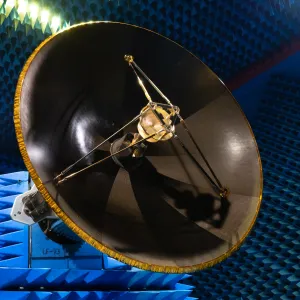
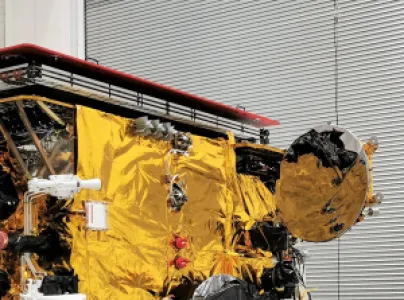
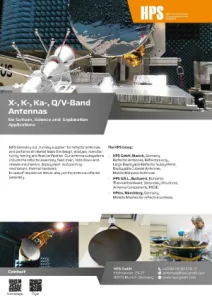
X-, K-, Ka-, Q/V-Band Antennas by HPS
HPS has implemented several antenna projects, such as:
- Heinrich Hertz Ka-band Antenna Subsystem
- HERA X-band Antenna
- GATEWAY-ESPRIT K-/S-band Antenna Reflector Assembly
- EUCLID ARA K-band High Gain Antenna Reflector Assembly
- HIDAN Reflector Development for High Directivity Beams at Q/V Band
- S3NGT-MWR Antenna Phase AB1
- SatComBw3 X-band Reflector.
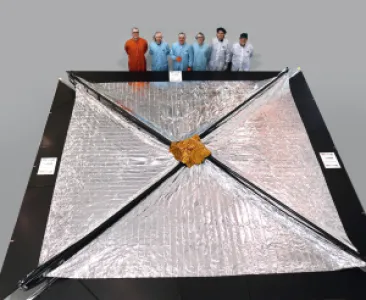
ADEO Deorbit Module
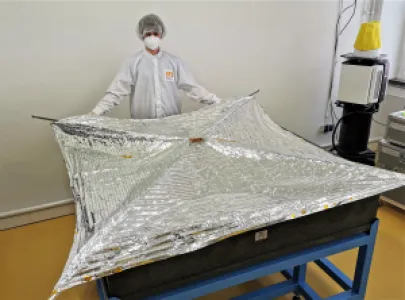
ADEO is a scalable drag augmentation device that uses the residual Earth atmosphere present in Low Earth Orbit (LEO) to passively deorbit satellites between 1 kg to 1,500 kg. A large surface is deployed which significantly increases the drag effect of the satellite´s surface to initiate the deorbit phase. In turn, this increase in surface area accelerates orbital decay.
The ADEO product line encompasses ADEO-P (1.7 m²), ADEO-C (3.4 m²), ADEO-Nx (2 m²), ADEO-N (5 m²), ADEO-M (15 m²), and ADEO-L (25 m²), offering scalable solutions tailored to different satellite configurations and mission needs.
The advantage of using a passive deorbiting system is that it does not require any additional propellant, nor active attitude control.
Passive deorbiting devices are therefore especially suitable for spacecraft without propulsion system to ensure compliance with deorbiting regulations.